Humanin (10mg) Research Peptide
Product Introduction
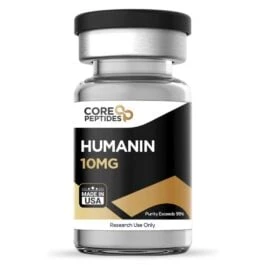
Humanin (10mg) is a research-grade peptide supplied by Core Peptides for laboratory and scientific research applications. Each vial contains 10mg of Humanin, providing researchers with a convenient quantity of peptide material for controlled experimental studies. Humanin is a small peptide associated with mitochondrial research and has been investigated in a range of cellular and molecular research contexts.
At Core Peptides, Humanin (10mg) is supplied with an emphasis on product quality, consistency, and reliable laboratory use. The product is intended exclusively for in-vitro and laboratory research and is not intended for human or veterinary use.
What Is Humanin?
Humanin is a small mitochondrial-derived peptide that has attracted scientific interest because of its relationship to cellular and mitochondrial biology. Researchers have investigated Humanin in experimental models examining cellular signaling, mitochondrial processes, and other biological pathways.
The scientific study of mitochondrial-derived peptides continues to develop, and Humanin provides researchers with a useful material for investigating peptide-related mechanisms in controlled laboratory environments. Its relatively small size also makes it suitable for experimental research where researchers require defined peptide sequences and consistent research materials.
Humanin (10mg) from Core Peptides is provided as research material rather than as a therapeutic product. Researchers can incorporate the peptide into appropriately designed laboratory protocols based on their specific experimental requirements.
Humanin Research Applications
Humanin has been studied in scientific research involving several areas of cellular and molecular biology. Research involving Humanin may examine peptide interactions, mitochondrial biology, cellular signaling, and other mechanisms of interest.
The exact experimental application, concentration, assay design, and methodology should be determined by qualified researchers according to their laboratory protocols and applicable institutional requirements. Core Peptides does not provide Humanin as a treatment or recommend it for use in people or animals.
The purpose of supplying Humanin (10mg) is to provide researchers with a consistent peptide material for controlled scientific investigation.
Product Specifications
| Specification |
Details |
| Product |
Humanin |
| Quantity |
10mg |
| Product Type |
Research peptide |
| Intended Use |
Laboratory and scientific research |
| Form |
Research-grade peptide material |
| Application |
In-vitro and experimental research |
| Human Use |
Not intended for human use |
| Veterinary Use |
Not intended for veterinary use |
Quality and Consistency
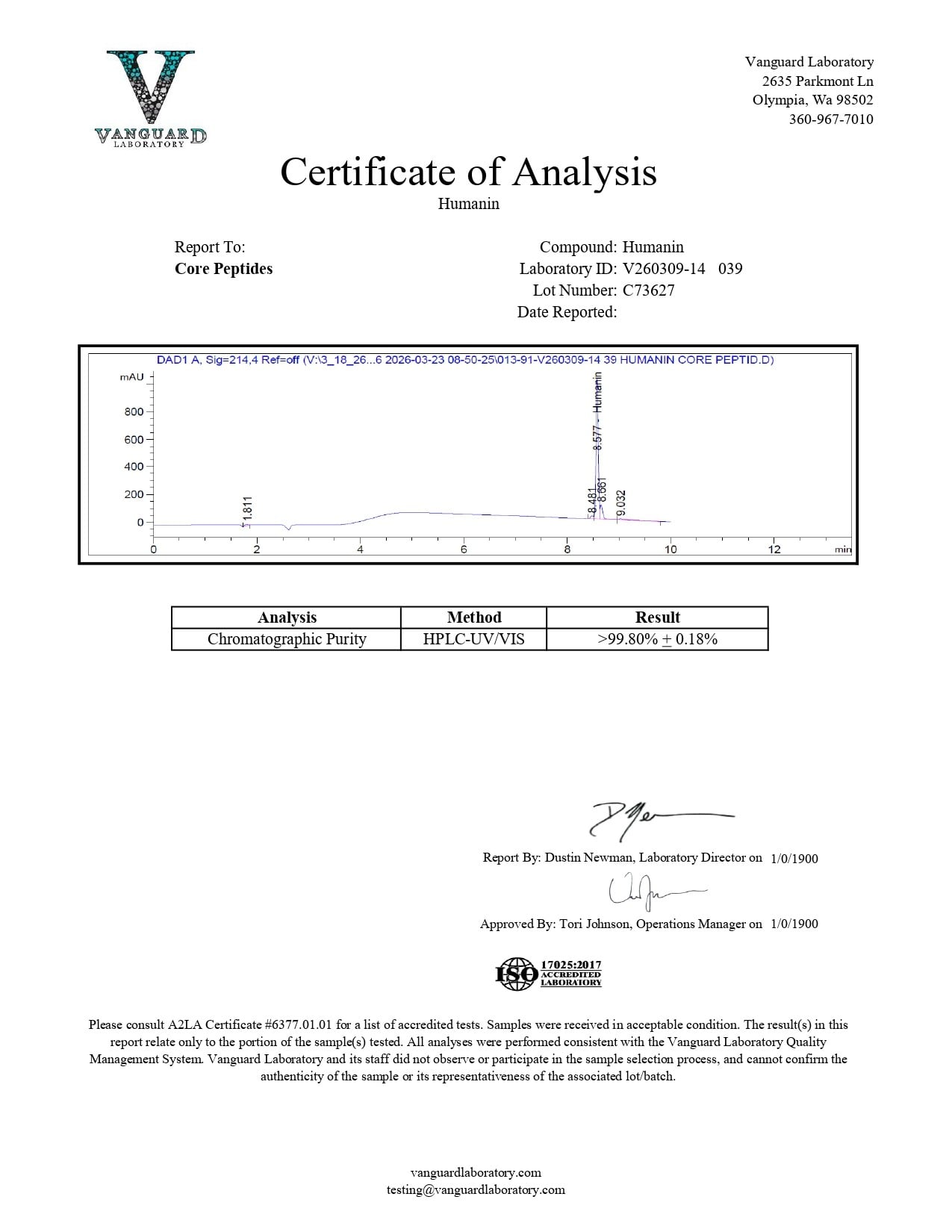
Reliable research depends on consistent laboratory materials. Humanin (10mg) is supplied with an emphasis on quality, identity, purity, and consistency. Researchers should review the applicable batch documentation and analytical information supplied with their order when evaluating a product for a particular experimental protocol.
Proper quality control is particularly important when working with peptide research materials because experimental results can be influenced by the characteristics and handling of the material being studied.
Packaging and Handling
Each Humanin (10mg) product is securely packaged to help protect the research material during storage and transportation. Researchers should follow appropriate laboratory procedures for receiving, handling, storage, and preparation of peptide materials.
Storage requirements can depend on the specific product formulation and laboratory protocol, so researchers should consult the applicable product documentation and follow established laboratory handling procedures.
Why Choose Core Peptides?
Core Peptides focuses on providing research-oriented peptide materials for laboratories, researchers, and scientific investigations. Humanin (10mg) offers researchers a convenient 10mg quantity of Humanin for controlled laboratory work.
Our product pages are designed to provide clear information about peptide identity, quantity, intended research use, and product handling so researchers can evaluate materials before incorporating them into their own laboratory workflows.
Research Use Disclaimer
Humanin (10mg) is supplied strictly for laboratory and scientific research purposes. It is not approved or intended for human consumption, self-administration, diagnosis, treatment, prevention, or mitigation of any disease or medical condition. It is also not intended for veterinary use. Researchers are responsible for following applicable laws, institutional requirements, laboratory safety procedures, and appropriate handling practices.
References:
- The origin of mitochondria and chloroplasts. https://www.nature.com/scitable/content/the-origin-of-mitochondria-and-chloroplasts-14747702/
- Lee, Changhan et al. “Humanin: a harbinger of mitochondrial-derived peptides?.” Trends in endocrinology and metabolism: TEM vol. 24,5 (2013). https://www.ncbi.nlm.nih.gov/pmc/articles/PMC3641182/
- Gong, Zhenwei et al. “Humanin and age-related diseases: a new link?.” Frontiers in endocrinology vol. 5 210. 4 Dec. 2014. https://www.ncbi.nlm.nih.gov/pmc/articles/PMC4255622/
- Hashimoto Y, Niikura T, Tajima H, Yasukawa T, Sudo H, Ito Y, Kita Y, Kawasumi M, Kouyama K, Doyu M, Sobue G, Koide T, Tsuji S, Lang J, Kurokawa K, Nishimoto I. A rescue factor abolishing neuronal cell death by a wide spectrum of familial Alzheimer’s disease genes and Abeta. Proc Natl Acad Sci U S A. 2001 May 22;98(11):6336-41. https://pubmed.ncbi.nlm.nih.gov/11371646/
- Yen K, Lee C, Mehta H, Cohen P. The emerging role of the mitochondrial-derived peptide humanin in stress resistance. J Mol Endocrinol. 2013 Jan 11;50(1):R11-9. https://pubmed.ncbi.nlm.nih.gov/23239898/
- Gong, Zhenwei et al. “Humanin and age-related diseases: a new link?.” Frontiers in endocrinology vol. 5 210. 4 Dec. 2014. https://www.ncbi.nlm.nih.gov/pmc/articles/PMC4255622/
- Guo B, Zhai D, Cabezas E, Welsh K, Nouraini S, Satterthwait AC, Reed JC. Humanin peptide suppresses apoptosis by interfering with Bax activation. Nature. 2003 May 22;423(6938):456-61. https://pubmed.ncbi.nlm.nih.gov/12732850/
- Ikonen M, Liu B, Hashimoto Y, Ma L, Lee KW, Niikura T, Nishimoto I, Cohen P. Interaction between the Alzheimer’s survival peptide humanin and insulin-like growth factor-binding protein 3 regulates cell survival and apoptosis. Proc Natl Acad Sci U S A. 2003 Oct 28;100(22):13042-7. https://pubmed.ncbi.nlm.nih.gov/14561895/
- Gong, Zhenwei et al. “Humanin and age-related diseases: a new link?.” Frontiers in endocrinology vol. 5 210. 4 Dec. 2014. https://www.ncbi.nlm.nih.gov/pmc/articles/PMC4255622/
- Sreekumar PG, Ishikawa K, Spee C, Mehta HH, Wan J, Yen K, Cohen P, Kannan R, Hinton DR. The Mitochondrial-Derived Peptide Humanin Protects RPE Cells From Oxidative Stress, Senescence, and Mitochondrial Dysfunction. Invest Ophthalmol Vis Sci. 2016 Mar;57(3):1238-53. https://pubmed.ncbi.nlm.nih.gov/26990160/
- Changhan Lee et al, IGF-I regulates the age-dependent signaling peptide humanin. Published 18 July 2014, Vol 13 Issue 5. https://onlinelibrary.wiley.com/doi/full/10.1111/acel.12243
- Zhang W, Zhang W, Li Z, Hao J, Zhang Z, Liu L, Mao N, Miao J, Zhang L. S14G-humanin improves cognitive deficits and reduces amyloid pathology in the middle-aged APPswe/PS1dE9 mice. Pharmacol Biochem Behav. 2012 Jan;100(3):361-9. https://pubmed.ncbi.nlm.nih.gov/21993310/
- Krejcova G, Patocka J, Slaninova J. Effect of humanin analogues on experimentally induced impairment of spatial memory in rats. J Pept Sci. 2004 Oct;10(10):636-9. https://pubmed.ncbi.nlm.nih.gov/15526713/
- Zhao, J., Zeng, Y., Wang, Y., Shi, J., Zhao, W., Wu, B., & Du, H. (2021). Humanin protects cortical neurons from calyculin A-induced neurotoxicities by increasing PP2A activity and SOD. The International journal of neuroscience, 131(6), 527–535. https://doi.org/10.1080/00207454.2020.1769617
- Hoang PT, Park P, Cobb LJ, Paharkova-Vatchkova V, Hakimi M, Cohen P, Lee KW. The neurosurvival factor Humanin inhibits beta-cell apoptosis via signal transducer and activator of transcription 3 activation and delays and ameliorates diabetes in nonobese diabetic mice. Metabolism. 2010 Mar;59(3):343-9. https://pubmed.ncbi.nlm.nih.gov/19800083/
- Zhenwei Gong et al, Central effects of humanin on hepatic triglyceride secretion, Endocrinology and Metabolism.
- Muzumdar, R. H., Huffman, D. M., Atzmon, G., Buettner, C., Cobb, L. J., Fishman, S., Budagov, T., Cui, L., Einstein, F. H., Poduval, A., Hwang, D., Barzilai, N., & Cohen, P. (2009). Humanin: a novel central regulator of peripheral insulin action. PloS one, 4(7), e6334. https://doi.org/10.1371/journal.pone.0006334
- Men J, Zhang X, Yang Y, Gao D. An AD-related neuroprotector rescues transformed rat retinal ganglion cells from CoCl₂-induced apoptosis. J Mol Neurosci. 2012 May;47(1):144-9. doi: 10.1007/s12031-011-9701-5. Epub 2012 Jan 5. https://pubmed.ncbi.nlm.nih.gov/22222604/
- Kariya S, Takahashi N, Hirano M, Ueno S. Humanin improves impaired metabolic activity and prolongs survival of serum-deprived human lymphocytes. Mol Cell Biochem. 2003 Dec;254(1-2):83-9. https://pubmed.ncbi.nlm.nih.gov/14674685/
- Xu X, Chua CC, Gao J, Hamdy RC, Chua BH. Humanin is a novel neuroprotective agent against stroke. Stroke. 2006 Oct;37(10):2613-9. Epub 2006 Sep 7. https://pubmed.ncbi.nlm.nih.gov/16960089/
- Sharp, T. E., 3rd, Gong, Z., Scarborough, A., Goetzman, E. S., Ali, M. J., Spaletra, P., Lefer, D. J., Muzumdar, R. H., & Goodchild, T. T. (2020). Efficacy of a Novel Mitochondrial-Derived Peptide in a Porcine Model of Myocardial Ischemia/Reperfusion Injury. JACC. Basic to translational science, 5(7), 699–714.
- Zhao H, Sonada S, Yoshikawa A, Ohinata K, Yoshikawa M. Rubimetide, humanin, and MMK1 exert anxiolytic-like activities via the formyl peptide receptor 2 in mice followed by the successive activation of DP1, A2A, and GABAA receptors. Peptides. 2016 Sep;83:16-20. https://pubmed.ncbi.nlm.nih.gov/27475912/
- Emma Eriksson, Malin Wickström, Lova Segerström Perup, John I. Johnsen, Staffan Eksborg, Per Kogner, Lars Sävendahl, Protective Role of Humanin on Bortezomib-Induced Bone Growth Impairment in Anticancer Treatment, JNCI: Journal of the National Cancer Institute, Volume 106, Issue 3, March 2014, djt459, https://doi.org/10.1093/jnci/djt459
Dr. Marinov
Dr. Marinov (MD, Ph.D.) is a researcher and chief assistant professor in Preventative Medicine & Public Health. Prior to his professorship, Dr. Marinov practiced preventative, evidence-based medicine with an emphasis on Nutrition and Dietetics. He is widely published in international peer-reviewed scientific journals and specializes in peptide therapy research.

Reviews
There are no reviews yet