
Hot
$44.00
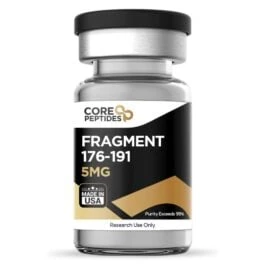
Size: 5mg
Contents: Fragment 176-191
Form: Lyophilized powder
Purity: >99%
SKU: P-FRAG176-191
FREE Shipping on $200+ orders
| Quantity | 5 – 8 | 9 + |
|---|---|---|
| Discount | 5% | 10% |
| Price | $41.80 | $39.60 |
Fragment 176-191 (5mg) is a research-grade peptide supplied exclusively for laboratory and scientific research applications. Each vial contains 5mg of Fragment 176-191, prepared with an emphasis on purity, consistency, and quality. Fragment 176-191 (5mg) is intended solely for laboratory research and is not intended for human or veterinary use.
Molecular Formula: C78H125N23O23S2
Molecular Weight: 1817.12 g/mol
Other Known Titles: hGH Fragment 176-191; Lipolytic fragment
As mentioned, Fragment 176-191 is believed to potentially increase fat burning through different mechanisms, which may include the upregulation of the beta-3 adrenergic receptors. More specifically, the peptide might elevate the expression levels of beta(3)-AR RNA in fat cells. This suggests that Fragment 176-191 may influence signaling pathways or transcription factors that enhance the production of beta-3 adrenergic receptor mRNA, leading to increased synthesis of the beta-3 adrenergic receptors protein. With more beta-3 adrenergic receptors present on the surface of adipocytes (fat cells), the cells may become more sensitive to lipolytic signals. This posits that even though Fragment 176-191 may not directly activate beta-3 adrenergic receptors, the increased number of receptors might amplify the natural lipolytic response to endogenous catecholamines (like adrenaline), which are suggested to engage these receptors directly. Fragment 176-191 might also activate other cellular signaling mechanisms that indirectly boost fat burning. For example, it may influence pathways that either upregulate the expression of enzymes involved in the lipolysis process or enhance the cellular response to lipolytic signals by modulating the activity of secondary messengers within the cell.
This has been explored by clinical trials, the most notable of which was METAOD005. This trial was initiated to explore the possible fat-burning action of a peptide. 300 test subjects were involved in this investigation, which lasted 12 weeks. There were six groups, including one control group and five Fragment 176-191 groups. It was suggested that one of the Fragment 176-191 groups experienced an apparent decrease in body weight, potentially by around 5.7 pounds. Moreover, it was posited that the peptide may have possibly contributed to improvements in the cholesterol levels and glucose tolerance of these participants.(6)
Some researchers have posited that Fragment 176-191 peptide may have some of the proposed regenerative properties of hGH, in addition to its apparent fat-burning potential. To explore these potential impacts of Fragment 176-191 peptide, researchers used a knee osteoarthritis model caused by collagenase. The experimental models were introduced with type II collagenase to apparently induce damage to the knee cartilage. Following this, for a period of 4-7 weeks, the models were split into four groups including saline (Group 1), hyaluronic acid (Group 2), Fragment 176-191 peptide (Group 3), and a combination of Fragment 176-191 peptide with hyaluronic acid (Group 4). The severity of the cartilage damage was evaluated through both morphological and histopathological analysis, and the degree of lameness was observed 8 weeks after the beginning of the trial. The researchers commented, “Mean gross morphological and histopathological scores were significantly higher in Group 1 than in Groups 2, 3, and 4, and the scores were significantly lower in Group 4 than in Groups 2 and 3. The lameness period in Group 4 was significantly shorter than those in Groups 1, 2, and 3.” This suggested that both hyaluronic acid and Fragment 176-191 peptide may be better than saline in stimulating an apparent cartilage regeneration, and the best research outcome may be achieved with a combination of Fragment 176-191 peptide and hyaluronic acid.(7)
In one study,(8) several synthetic hGH peptides, including Fragment 176-191, were presented in normal functioning murine models to determine its potential on glycogen metabolism. Upon delivery, it was reported that the peptide appeared to induce a slight increment in levels of blood glucose and lactate, with a slight reduction in the ratio of glycogen synthase in muscle, adipose tissues, and the liver. It was suggested that this outcome was due to the peptide’s apparent action of converting the enzymes from their active state to inactive state, as the total synthase levels appeared to remain at constant concentrations.
Fragment 176-191 peptide is available for research and laboratory purposes only. Please review and adhere to our Terms and Conditions before ordering.
Dr. Marinov (MD, Ph.D.) is a researcher and chief assistant professor in Preventative Medicine & Public Health. Prior to his professorship, Dr. Marinov practiced preventative, evidence-based medicine with an emphasis on Nutrition and Dietetics. He is widely published in international peer-reviewed scientific journals and specializes in peptide therapy research.
No account yet?
Create an AccountText me with offers and updates
We promise not to spam you. Read our privacy policy for more information.
Reviews
There are no reviews yet