GHRP-2 (5mg / 10mg) Research Peptide
Product Introduction
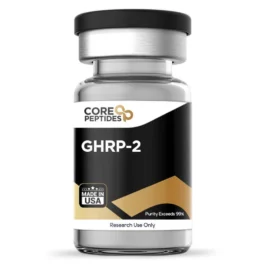
GHRP-2 (5mg / 10mg) is a research-grade peptide supplied by Core Peptides for laboratory and scientific research applications. Available in 5mg and 10mg quantities, GHRP-2 is a synthetic peptide that has been extensively investigated in research involving peptide signaling, receptor activity, and growth-hormone-related pathways.
GHRP-2, also known as Growth Hormone-Releasing Peptide-2, provides researchers with a defined peptide material for controlled laboratory investigations. Each quantity is supplied with an emphasis on quality, consistency, and reliable research use. GHRP-2 (5mg / 10mg) is intended exclusively for laboratory research and is not intended for human or veterinary use.
What Is GHRP-2?
GHRP-2 is a synthetic peptide belonging to the growth hormone-releasing peptide family. It has been studied extensively as a research tool for investigating interactions between peptide compounds and specific cellular receptors.
Scientific research involving GHRP-2 can help researchers better understand peptide-mediated signaling and the mechanisms associated with growth-hormone-related pathways. Its defined molecular structure makes it useful in controlled experimental settings where researchers are examining receptor interactions, signaling responses, and related biological processes.
GHRP-2 (5mg / 10mg) is supplied as research material and should be incorporated only into appropriately designed laboratory protocols.
GHRP-2 Research Applications
GHRP-2 is relevant to research involving peptide signaling, receptor biology, endocrine research, and molecular biology. Researchers may use GHRP-2 in controlled experimental models to investigate peptide-receptor interactions and downstream signaling pathways.
Potential laboratory research applications can include biochemical assays, receptor-binding studies, cellular research, and other experimental systems where GHRP-related signaling is being investigated.
The appropriate experimental concentration, assay methodology, controls, and handling procedures should be established by qualified researchers according to their specific laboratory protocols.
Available Quantities
Core Peptides offers GHRP-2 in two research quantities:
- 5mg — suitable for laboratory studies requiring a smaller research quantity.
- 10mg — provides a larger quantity for research projects requiring additional peptide material.
Both options contain GHRP-2 research peptide and are intended exclusively for laboratory and scientific applications.
Product Specifications
| Specification |
Details |
| Product |
GHRP-2 |
| Available Quantities |
5mg / 10mg |
| Product Type |
Research peptide |
| Alternative Name |
Growth Hormone-Releasing Peptide-2 |
| Intended Use |
Laboratory and scientific research |
| Research Areas |
Peptide, receptor, endocrine and molecular research |
| Human Use |
Not intended for human use |
| Veterinary Use |
Not intended for veterinary use |
Quality and Consistency
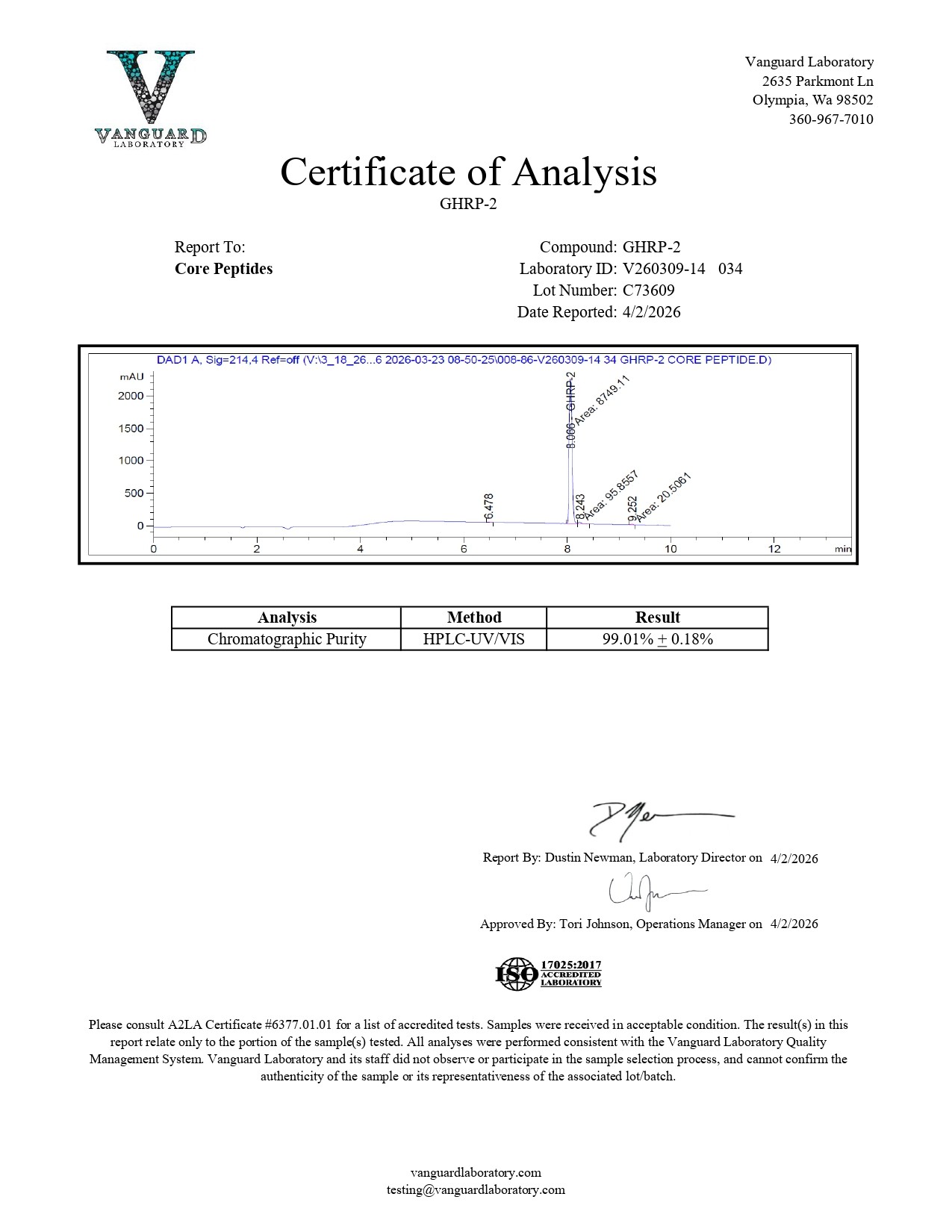
Reliable research requires consistent laboratory materials. GHRP-2 (5mg / 10mg) is supplied with an emphasis on product quality, consistency, and suitability for controlled research applications.
Researchers should review available analytical and batch documentation when evaluating GHRP-2 for a specific experiment. Appropriate laboratory controls and validated analytical methods should be used when assessing research materials within an experimental system.
Packaging and Handling
GHRP-2 is securely packaged to help protect the research material during storage and transportation. Researchers should follow the applicable product documentation and established laboratory procedures for storage, handling, and preparation.
Laboratories should always use appropriate safety procedures when working with research peptides and other laboratory materials.
Why Choose Core Peptides?
Core Peptides provides research-oriented peptide materials for laboratories, researchers, and scientific investigations. With GHRP-2 (5mg / 10mg), researchers can select the quantity that best fits their laboratory requirements.
Our goal is to provide clearly identified research materials with straightforward product information, consistent presentation, and secure packaging for laboratory use.
Research Use Disclaimer
GHRP-2 (5mg / 10mg) is supplied strictly for laboratory and scientific research purposes. It is not approved or intended for human consumption, self-administration, diagnosis, treatment, prevention, or mitigation of any disease or medical condition. It is not intended for veterinary use. Researchers are responsible for complying with applicable laws, institutional requirements, laboratory safety standards, and appropriate handling procedures.
Product Features
- Available in 5mg and 10mg quantities
- Synthetic GHRP-2 research peptide
- Research-grade laboratory material
- Suitable for peptide and molecular research
- Relevant to receptor and endocrine research
- Quality-focused production
- Secure packaging
- For research use only
- Not for human or veterinary use
References:
- Garcia JM, Merriam GR, Kargi AY. Growth Hormone in Aging. In: Feingold KR, Anawalt B, Boyce A, et al., editors. Endotext. South Dartmouth (MA): MDText.com https://www.ncbi.nlm.nih.gov/books/NBK279163/
- Laferrère, Blandine et al. “Growth hormone releasing peptide-2 (GHRP-2), like ghrelin, increases food intake in healthy men.” The Journal of clinical endocrinology and metabolism vol. 90,2 (2005): 611-4. https://www.ncbi.nlm.nih.gov/pmc/articles/PMC2824650/
- Bowers CY. History to the discovery of ghrelin. Methods Enzymol. 2012;514:3-32. doi: 10.1016/B978-0-12-381272-8.00001-5. PMID: 22975043. https://pubmed.ncbi.nlm.nih.gov/22975043/
- Roh SG, He ML, Matsunaga N, Hidaka S, Hidari H. Mechanisms of action of growth hormone-releasing peptide-2 in bovine pituitary cells. J Anim Sci. 1997 Oct;75(10):2744-8. doi: 10.2527/1997.75102744x. PMID: 9331879. https://pubmed.ncbi.nlm.nih.gov/9331879/
- Asad Rahim, Stephen M. Shalet, in Growth Hormone Secretagogues, 1999. Does desensitization to growth hormone secretagogues occur? https://www.sciencedirect.com/topics/medicine-and-dentistry/pralmorelin
- Furuta S, Shimada O, Doi N, Ukai K, Nakagawa T, Watanabe J, Imaizumi M. General pharmacology of KP-102 (GHRP-2), a potent growth hormone-releasing peptide. Arzneimittelforschung. 2004;54(12):868-80. doi: 10.1055/s-0031-1297042. PMID: 15646371. https://pubmed.ncbi.nlm.nih.gov/15646371/
- Emanuela Arvat, Lidia Di Vito, Barbara Maccagno, Fabio Broglio, Muni F Boghen, Romano Deghenghi, Franco Camanni, Ezio Ghigo, Effects of GHRP-2 and Hexarelin, Two Synthetic GH-Releasing Peptides, on GH, Prolactin, ACTH and Cortisol Levels in Man. Comparison with the Effects of GHRH, TRH and hCRH, Peptides, Volume 18, Issue 6, 1997, Pages 885-891, ISSN 0196-9781, https://doi.org/10.1016/S0196-9781(97)00016-8
- Chihara K, Shimatsu A, Hizuka N, Tanaka T, Seino Y, Katofor Y; KP-102 Study Group. A simple diagnostic test using GH-releasing peptide-2 in adult GH deficiency. Eur J Endocrinol. 2007 Jul;157(1):19-27. doi: 10.1530/EJE-07-0066. https://pubmed.ncbi.nlm.nih.gov/17609397/
- Pihoker C, Middleton R, Reynolds GA, Bowers CY, Badger TM. Diagnostic studies with intravenous and intranasal growth hormone-releasing peptide-2 in children of short stature. J Clin Endocrinol Metab. 1995 Oct;80(10):2987-92. https://pubmed.ncbi.nlm.nih.gov/7559885/
- Van den Berghe G, Baxter RC, Weekers F, Wouters P, Bowers CY, Iranmanesh A, Veldhuis JD, Bouillon R. The combined administration of GH-releasing peptide-2 (GHRP-2), TRH and GnRH to men with prolonged critical illness evokes superior endocrine and metabolic effects compared to treatment with GHRP-2 alone. Clin Endocrinol (Oxf). 2002 May;56(5):655-69. https://pubmed.ncbi.nlm.nih.gov/12030918/
- GHRP 2, GPA 748, Growth Hormone-Releasing Peptide 2, KP-102 D, KP-102 LN, KP-102D, KP-102 LN. https://link.springer.com/article/10.2165/00126839-200405040-00011#
- Phung LT, Sasaki A, Lee HG, Vega RA, Matsunaga N, Hidaka S, Kuwayama H, Hidari H. Effects of the administration of growth hormone-releasing peptide-2 (GHRP-2) orally by gavage and in feed on growth hormone release in swine. Domest Anim Endocrinol. 2001 Jan;20(1):9-19. https://pubmed.ncbi.nlm.nih.gov/11164330/
- Yin, Y., Li, Y., & Zhang, W. (2014). The growth hormone secretagogue receptor: its intracellular signaling and regulation. International journal of molecular sciences, 15(3), 4837–4855. https://doi.org/10.3390/ijms15034837
- Sinha, D. K., Balasubramanian, A., Tatem, A. J., Rivera-Mirabal, J., Yu, J., Kovac, J., Pastuszak, A. W., & Lipshultz, L. I. (2020). Beyond the androgen receptor: the role of growth hormone secretagogues in the modern management of body composition in hypogonadal males. Translational andrology and urology, 9(Suppl 2), S149–S159. https://doi.org/10.21037/tau.2019.11.30
- Titterington JS, Sukhanov S, Higashi Y, Vaughn C, Bowers C, Delafontaine P. Growth hormone-releasing peptide-2 suppresses vascular oxidative stress in ApoE-/- mice but does not reduce atherosclerosis. Endocrinology. 2009 Dec;150(12):5478-87. doi: 10.1210/en.2009-0283. Epub 2009 Oct 9. PMID: 19819949; PMCID: PMC2795722.
- Li, G., Li, J., Zhou, Q., Song, X., Liang, H., & Huang, L. (2010). Growth hormone releasing peptide-2, a ghrelin agonist, attenuates lipopolysaccharide-induced acute lung injury in rats. The Tohoku journal of experimental medicine, 222(1), 7–13. https://doi.org/10.1620/tjem.222.7
- Veldhuis, J. D., Keenan, D. M., Bailey, J. N., Adeniji, A. M., Miles, J. M., & Bowers, C. Y. (2009). Novel relationships of age, visceral adiposity, insulin-like growth factor (IGF)-I and IGF binding protein concentrations to growth hormone (GH) releasing-hormone and GH releasing-peptide efficacies in men during experimental hypogonadal clamp. The Journal of clinical endocrinology and metabolism, 94(6), 2137–2143. https://doi.org/10.1210/jc.2009-0136
- Veldhuis, J. D., & Keenan, D. M. (2008). Secretagogues govern GH secretory-burst waveform and mass in healthy eugonadal and short-term hypogonadal men. European journal of endocrinology, 159(5), 547–554. https://doi.org/10.1530/EJE-08-0414
- Bowers, C. Y., Granda, R., Mohan, S., Kuipers, J., Baylink, D., & Veldhuis, J. D. (2004). Sustained elevation of pulsatile growth hormone (GH) secretion and insulin-like growth factor I (IGF-I), IGF-binding protein-3 (IGFBP-3), and IGFBP-5 concentrations during 30-day continuous subcutaneous infusion of GH-releasing peptide-2 in older men and women. The Journal of clinical endocrinology and metabolism, 89(5), 2290–2300. https://doi.org/10.1210/jc.2003-031799
- Sheriff, S., Joshi, R., Friend, L. A., James, J. H., & Balasubramaniam, A. (2009). Ghrelin receptor agonist, GHRP-2, attenuates burn injury-induced MuRF-1 and MAFbx expression and muscle proteolysis in rats. Peptides, 30(10), 1909–1913. https://doi.org/10.1016/j.peptides.2009.06.029
- Sigalos, J. T., & Pastuszak, A. W. (2018). The Safety and Efficacy of Growth Hormone Secretagogues. Sexual medicine reviews, 6(1), 45–53. https://doi.org/10.1016/j.sxmr.2017.02.004
Dr. Marinov
Dr. Marinov (MD, Ph.D.) is a researcher and chief assistant professor in Preventative Medicine & Public Health. Prior to his professorship, Dr. Marinov practiced preventative, evidence-based medicine with an emphasis on Nutrition and Dietetics. He is widely published in international peer-reviewed scientific journals and specializes in peptide therapy research.

Reviews
There are no reviews yet